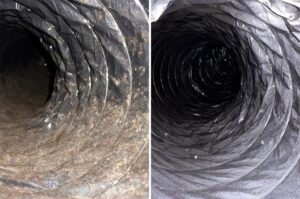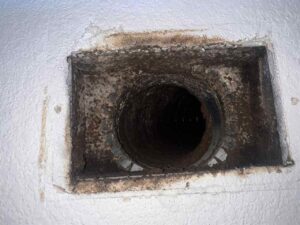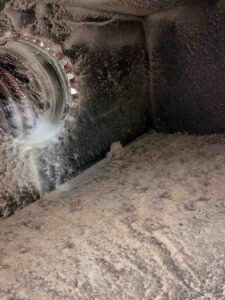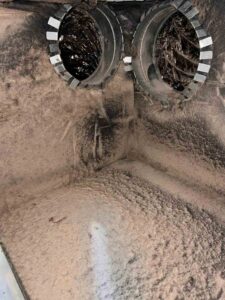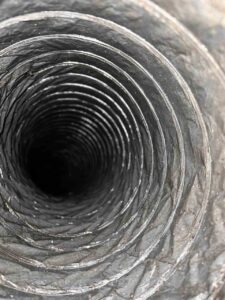
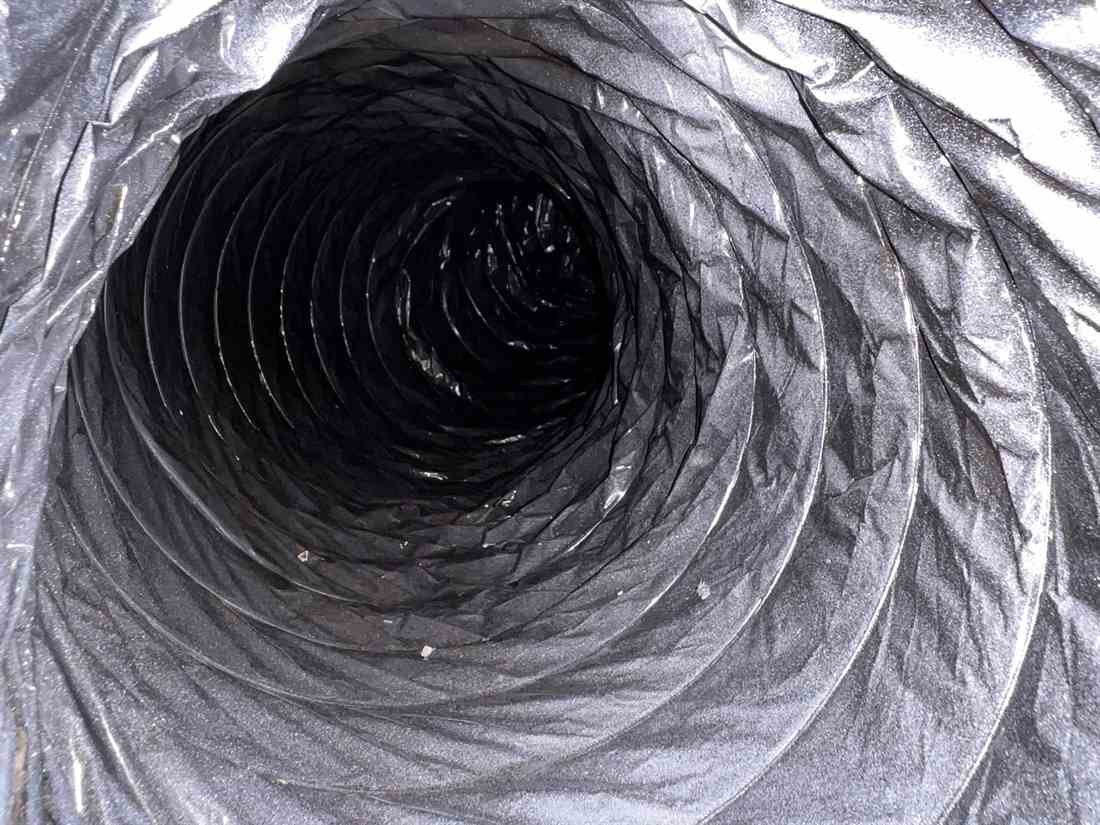
Here is the assumption that costs new-home owners the most: the house is brand new, so the ducts must be clean. In our experience across DFW, the opposite is usually true. A new build is the one house on the street where nobody has ever opened the duct system, and it is often the dirtiest ductwork we see all year. That is not a knock on your builder. It is simply what happens to an open duct system that sits inside an active construction site for months.
Why a brand-new duct system is usually a dirty one
The ductwork goes in early, long before the house is finished. From that point on it sits open while crews cut and hang drywall, sand joints, cut tile and trim, and sweep floors. Every one of those steps throws fine particulate into the air, and gravity puts a share of it straight into the open supply runs. Then comes the part that does the real damage: if the builder ran the HVAC to cool or dry the house before closing, the system pulled all of that airborne debris through the returns and packed it into the ribbing of the flex duct.
That is why what we pull out of a new build is rarely just dust. We have opened supply runs in year-old homes and found soda bottles, drink cans, lumber offcuts, drywall screws, and torn scraps of insulation. The fine material is the bigger problem, but the debris tells you how open the system really was.
Drywall dust is not the same as house dust
This is the part most homeowners miss. Ordinary household dust is soft, mostly organic, and sits loose in the duct. Drywall dust is gypsum: it is far finer, it is abrasive, and it slips past a standard 1-inch filter instead of being caught by it. Once the blower has driven it into the ribbed liner of a flex run, it cakes in place and will not come out with a shop vacuum.
It also does not stay in the ductwork. Gypsum powder works into the blower wheel and settles on the aluminum fins of the evaporator coil, where it behaves like an insulating blanket over the part of your system that is supposed to be moving heat. The result is weaker cooling, longer run cycles, and extra strain on the compressor during a North Texas summer. We documented exactly this pattern on a Richardson home buried in drywall dust after a remodel, and it is the same gypsum, the same coil, and the same recurring white film on the counters.
The signs your new build has construction debris in the ducts
Construction dust announces itself faster than normal dust does. Watch for these in the first year:
- A chalky white film that comes back. You wipe the counters and the hardwood on Saturday, and by Tuesday there is a fine haze again. That is gypsum being redistributed every time the system cycles.
- Filters loading up in weeks, not months. If a filter that should last three months is gray at four weeks, the system is pulling particulate from inside itself.
- Allergy symptoms in the cleanest house on the street. Insulation fibers and fine gypsum are respiratory irritants, and a brand-new, tightly sealed home gives them nowhere to escape.
- A sawdust or new-construction smell on start-up. A distinct dry, dusty odor in the first few seconds after the blower kicks on.
- Rooms that will not hold temperature. Debris in the runs and dust on the coil both cut airflow, and the far bedrooms feel it first.
Construction debris vs. routine household dust
The distinction matters because it changes what the job actually requires.
| Feature | Routine household dust | Post-construction debris |
|---|---|---|
| What it is | Skin cells, fabric fibers, pollen, pet dander | Gypsum powder, sawdust, insulation fibers, jobsite trash |
| How it behaves | Soft, sits loose in the run | Fine and abrasive, cakes into the flex liner |
| Where it ends up | Mostly the ducts and registers | Ducts, blower wheel, and the evaporator coil |
| What it takes to remove | Standard source-removal cleaning | Full clean-out plus hand-cleaning the blower and coil |
| When it is due | Every 3 to 5 years | Once, shortly after you take possession |
What a real post-construction clean-out involves
This is deep-cleaning territory, and it is worth knowing what a proper job looks like before you book one:
- Camera first, tools second. We map the runs with a fiber-optic duct camera so we know what is in there and how the system is built. A new build is almost always flexible ducting, which rules out rigid metal brushes.
- Tooling matched to the duct. Flex duct is a thin liner over a wire helix. Soft nylon spinning brushes on flexible rods expand gently to the pipe diameter and lift gypsum out of the ribbing without stressing the wire frame.
- Negative air on the plenum. A dual-HEPA negative-air machine tapped into the return plenum pulls the loosened powder out of the house instead of redistributing it.
- The blower and coil by hand. Skipping this is the most common shortcut. If the gypsum stays on the coil, the cooling problem stays with it.
- Photo proof. Before-and-after images from inside your own ductwork, so you are not taking anyone’s word for it.
Timing: do it before the house fills up
The best window is right after closing and before the furniture, rugs, and boxes go in. An empty house is faster to work in, and it means the construction dust comes out before it has a chance to settle into everything you own.
If the builder tells you the ducts were already cleaned, ask one specific question: what equipment was used? A quick pass with a portable vacuum at final walkthrough is a courtesy, not a source-removal cleaning, and it will not touch gypsum that is packed into a flex liner. If you are not sure either way, an air duct inspection with a camera will settle it in one visit.
What it should cost, and what to watch for
A post-construction clean-out is a heavier job than routine maintenance, and an honest company will tell you that before the truck is in your driveway, not after. As with every job we quote, the price is set by the number of AC systems, the count of vents and returns, and the condition of the system, never by a flat coupon that ignores all three. That is also why we inspect before we quote: you should not pay for a deep clean-out if your system does not need one, and you should not be sold a bargain-priced pass that cannot remove what is actually in your ducts. Our full breakdown of how honest duct cleaning pricing works in Dallas covers those traps in detail.
The good news is that this is a one-time correction. Once the construction debris is out, your brand-new system goes on the same 3-to-5 year maintenance cycle as every other home in Frisco, McKinney, or Richardson.
If you just closed on new construction anywhere in DFW, have the ducts looked at before you settle in. Call the Warrior team at (469) 902-2922 for a straight answer and a clear quote based on your actual system.